

Where Exactly Is It?
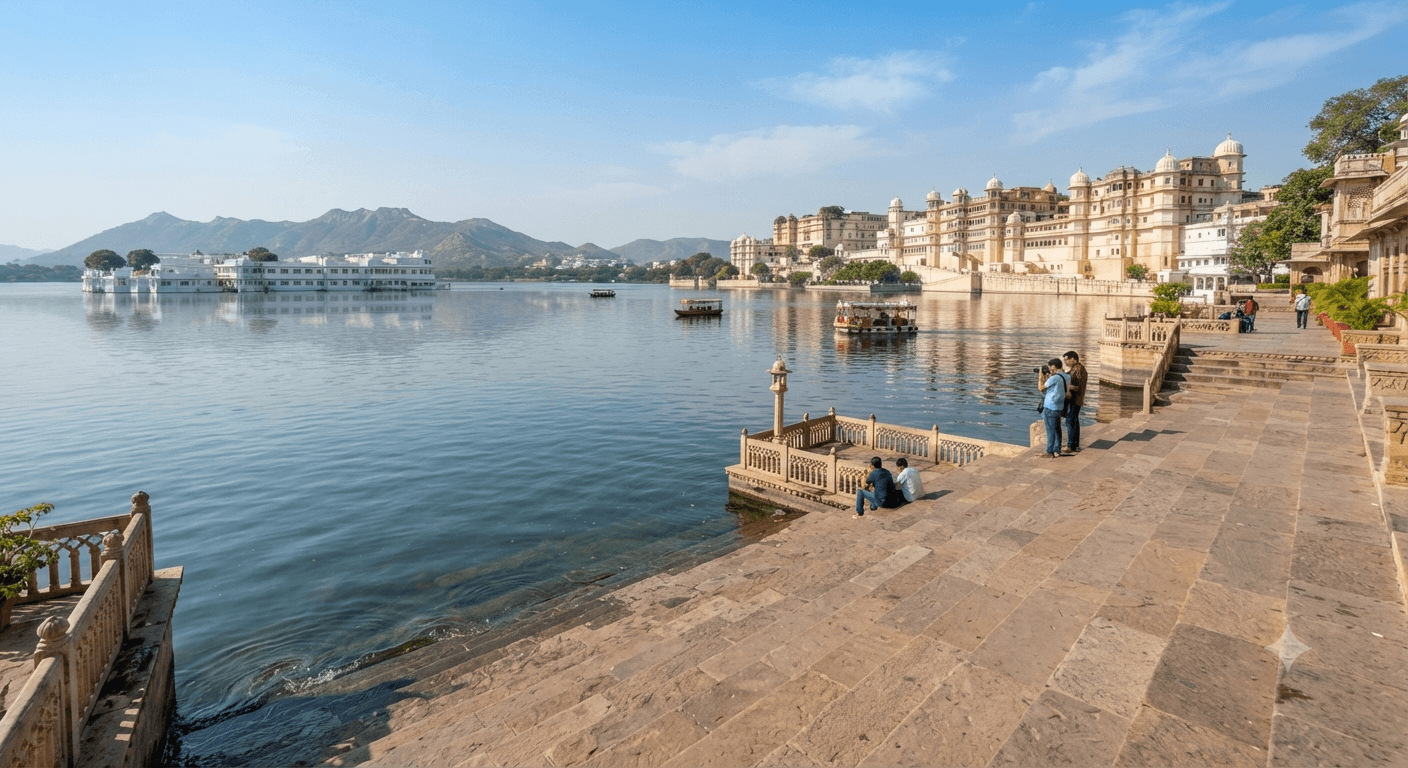
Ambrai Ghat sits on the Lake Pichola waterfront in Udaipur’s Old City. It is close to Chandpole and the Maji Ka Mandir area. It looks straight across at the lake’s most photographed cluster: the City Palace, the Lake Palace, and Jag Mandir. That view is the entire reason this particular stretch of steps became famous instead of one of the dozen others around the lake.
Some sites call it the eastern bank. Some call it the western one. We’re not going to pick a side until it’s confirmed against a current map. Guessing at geography is a good way to send someone the wrong direction. Your phone will get you there faster than our compass sense will.
Ambrai, Manjhi, or Hanuman Ghat?
Most write-ups skip past this. Ambrai Ghat also goes by Manjhi Ghat. A handful of sources throw in Hanuman Ghat as a third name for the same steps. Are all three names for one physical place? Or has someone folded in a neighbouring ghat or temple along the way? It is hard to say from a desk. Everyone online seems to be citing everyone else rather than checking the source.
Ask an auto driver near Chandpole what he actually calls it. You’ll probably get a cleaner answer than this paragraph.
A Short History — Minus the Guesswork
You’ll run into claims that the ghat dates back to the 16th century. There is also a story about Maharana Udai Singh II stumbling on it during a hunting trip. It’s a nice detail. However, we found no solid backing for it. We’re treating it as folklore rather than fact until someone can point to an actual record.
Here’s what holds up: Ambrai Ghat is part of Udaipur’s much older Lake Pichola waterfront. It was shaped over centuries by royal building projects, religious ritual, and plain everyday life beside the water. It is less dramatic than “founded by a king.” Unlike that story, it is actually true.
What You Can Actually See From Here
This is the one thing every source agrees on. Let’s do it properly instead of just writing “beautiful views” and calling it a day. Standing on the ghat and looking out:
- City Palace runs along the shoreline to your right.
- The Lake Palace floats near the middle of the water (Jag Niwas, if you want the formal name).
- Jag Mandir sits further out.
- The Aravalli hills fill in the skyline behind everything.
- The lake does its actual job — boats, other ghats, and people going about a Tuesday instead of just posing for a photo.
If you’ve brought a camera, don’t plant yourself at the first spot you like. Walk the length of the ghat first. The angle on the Lake Palace changes more than you’d expect over even twenty metres.
Sunrise Gets Skipped, and Shouldn’t
Nearly every article about this place talks about sunset. Almost none mention that sunrise is the more honest version of it. It’s cooler, quieter, and features the lake behaving the way it does on an ordinary morning rather than performing for an audience. If you want to see Ambrai Ghat the way people who actually live here see it, this is your window. Do not aim for 6 p.m.
Sunset Is Still the Main Event
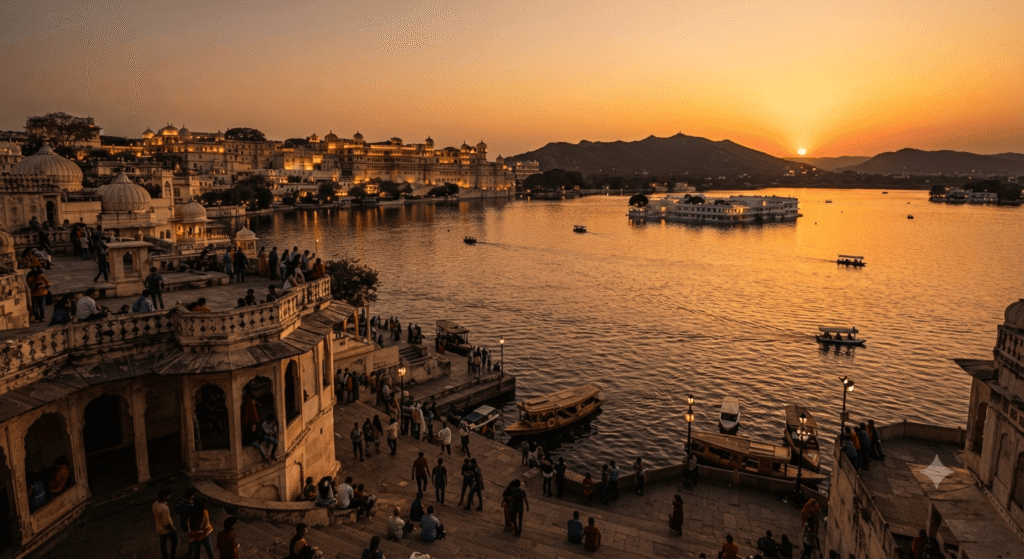
No point pretending otherwise — sunset is why this place has a reputation. The light does something to the water and the palace facades that makes even a phone camera look decent. That is exactly why “Udaipur’s best sunset spot” shows up on every list within reach.
Looking for more options? Check out our guide to the 7 Best Sunset Points in Udaipur to find your next favorite spot.
Fairer to say it’s one of the most popular sunset points in the city. Popular means shared. Get there before you think you need to if you want an unobstructed view.
After Dark
The palaces light up and the whole scene shifts. City Palace and the Lake Palace both take on a warm reflected glow. The sunset crowd thins out into couples and photographers who stuck around. What nobody can tell us with confidence is exactly how late the ghat stays properly lit and open. The sources disagree here just like they do on daytime hours. It is worth a quick check locally if an evening visit is part of the plan.
Beyond the View: The Part That Isn’t Written Yet
Most Ambrai Ghat content stops looking the moment the view’s been described. It starts guessing at everything else. That guessing is actually the opportunity. Some sources say locals still bathe here and use the ghat day to day, tourist traffic or not. A couple tie it to Gangaur processions and Jal-Jhulni Ekadashi rituals. It is plausible, but we’d rather confirm the specifics locally than print a festival calendar built on secondhand mentions.
None of this can be written from a search results page. It takes five minutes with someone who’s actually watched the place for twenty or thirty years — a boatman, a shopkeeper, a priest, or whoever’s around. What did people call it before tourists showed up with cameras? Who’s actually here at six in the morning? That’s the piece no aggregator site can copy. It belongs in this article before it goes live.
Photography: What to Shoot and Where to Stand
Early morning gives you clean, uncrowded shots of the ghat and the lake. Golden hour is the classic palace-and-water frame everyone’s chasing. Blue hour, right after sunset, has a moodier quality before the lights fully take over. Once the palaces are lit, you get the reflections. This is arguably the most underused shot of the four.
Walk before you shoot. The best line on the Lake Palace usually isn’t from directly in front of the main steps.
Ambrai Ghat vs. Ambrai Restaurant
Two different things are constantly confused. Ambrai Ghat is the public lakefront, free to walk onto whenever it’s open. Ambrai Restaurant, next door at Amet Haveli, is a paid dining venue. It shares the name and roughly the same view. Nobody needs a reservation to sit on the public steps and watch the sunset. The restaurant is just a pricier way to watch the same thing from a table instead of a stone step.
Getting There
Walk in from Jagdish Chowk through the Old City lanes if you can. It’s a more interesting route than a taxi drop-off. It takes you past the kind of narrow, shop-lined streets that never show up on a map recommendation. Coming by auto or cab means a short walk after you’re dropped. Vehicles can’t reach the water’s edge directly. Parking near the ghat is reportedly tight. If you’re driving yourself, leave extra time to find a spot, or just plan to walk the last stretch either way.
Timings and Entry Fee: The Part We Won’t Fake
We won’t hand you a confident number here because the sources flatly contradict each other. Google’s current listing shows 5 AM to 7 PM. Other sites list 24-hour access, or 8 to 7, or attach those hours to the aarti schedule instead of general entry. The fee situation is just as messy. Most say it’s free. One lists a detailed breakdown with separate charges for Indian visitors, foreign visitors, cameras, and pre-wedding shoots.
Here’s the straight version instead of a guess: check current hours and any entry charge locally on the day you go. You can also check Google Maps. This is especially important for an early-morning or after-dark visit. This section gets updated with a confirmed number the moment it’s actually been checked on-site, rather than copied from somewhere else.
What to Pair It With
Think of it as a route rather than a checklist. Start at Jagdish Temple, then take a walk through the Old City lanes. Next, head to Ambrai Ghat for sunset. Finish with dinner somewhere close by. Gangaur Ghat sits directly across the water. Bagore Ki Haveli and Amet Haveli are both nearby too. Altogether, it makes an easy half-day loop instead of a single stop you tick off and leave.
Before You Go
Reviews are strongly positive on the obvious stuff — the view, the sunset, the photos — but not unanimously glowing. Maintenance and cleanliness come up more than once. Plenty of visitors leave feeling it’s “just another ghat” once the initial view wears off. It is good to know going in that this is a place worth seeing, not a place that’s going to feel private or spotless.
Bring shoes that can handle stone steps. Expect company at sunset no matter what day you show up. Don’t trust whichever opening-hours listing happens to load first.
UdaipurDiary’s Take
Ambrai Ghat earns its reputation. The view holds up regardless of which Google listing you believe. However, online, it has been flattened into a postcard: sunset, palace, done.
The more interesting version of this place is the one still standing at six in the morning, before anyone’s shown up with a camera. It’s the one that will still be standing in fifty years, no matter what today’s hours listing says. That’s the ghat worth visiting. The postcard is just what gets photographed.